Referral commission arrangements between laboratories and referring doctors are a normal commercial fact in this market, and they are also the single most reliable source of month-end friction in a lab's calendar. The argument is almost never about the rate — that was agreed months ago. It is about the count.
This article is about the mechanics: which models labs use, why disputes arise structurally rather than through anyone's dishonesty, and what a record both sides can accept looks like.
Two things we will not do. We will not publish "typical" commission rates by test category — nobody audits this market, and a made-up figure presented as a norm would become a bargaining chip in other people's negotiations. And we will not pretend the practice is uncontroversial: referral incentives are ethically contested in medicine and regulated differently in different jurisdictions, on the reasoning that a test should be ordered because a patient needs it. Whether and how you participate is your decision, and it is worth knowing your local rules. What this article can do is make the record-keeping honest, which serves everyone regardless of where they land on the rest.
The Models Labs Actually Use
Three shapes, and the differences matter mostly at the edges — discounts, panel work and expensive tests.
Percentage of the invoice. An agreed share of what the patient actually paid on that referral. Simple to state and simple to compute. Its complication is discounts, dealt with below, because "what the patient paid" and "what the test lists at" stop being the same number the moment a discount is given.
Fixed fee per test. An agreed amount per test regardless of the invoice. It removes the discount ambiguity entirely, which is why some labs prefer it. Its complication is maintenance — a fixed fee agreed against last year's prices quietly drifts as your rate list moves, so it needs a review date.
Per-doctor test pricing. Rather than a share, the doctor's referrals are billed at an agreed price per test, and the difference from your list price is the arrangement. This handles specialist or panel arrangements cleanly and is how some longer-standing relationships are actually structured in practice.
Tiered or volume-based. A rate that changes above a monthly threshold. Straightforward in principle, and worth being cautious about: tiers create a cliff at the boundary, and cliffs create arguments about which side of the month a particular referral fell on.
Whichever model, write down four things: the rate, the base it applies to, how discounts are handled, and when it is reviewed. Most disputes are traceable to one of those four never having been stated.
Where Disputes Actually Come From
Not from dishonesty, in the overwhelming majority of cases. From two records that were never going to agree.
Both sides keep their own tally. The doctor's clinic notes who was sent; the lab's register records who arrived. These two counts diverge naturally — a patient sent on Tuesday arrives on Friday, another was referred but went elsewhere, a third came on their own after being told about you months ago. By month end there are two numbers and no way to reconcile them, because neither record contains the other's evidence.
Discounts applied after the fact. The receptionist gives a walk-in discount at the counter. Is the commission on the list price or the discounted price? If that was never settled, both readings are reasonable and both parties will hold the one that favours them.
Walk-ins who mention a doctor's name. The patient says Dr So-and-so recommended the lab, but is not carrying a prescription. Counted or not? Labs differ, and the answer needs to be a policy rather than a decision made per-patient by whoever is on the counter.
Referrals recorded late. The doctor's name is captured at report time rather than at registration, from memory, days later. This is where the count degrades most and is the easiest of the four to fix.
Cancelled, refunded and unpaid tests. Sample rejected, patient did not pay, test not performed. If the arrangement does not say, each of these is a small argument waiting for month end.
A Record Both Sides Can Trust
The fix is structural rather than a matter of goodwill: capture the referral at registration, on the invoice, at the moment the patient is standing there.
That single habit resolves most of the list above. The referring doctor becomes part of the transaction record rather than a recollection, attached to a specific invoice with a specific date and a specific amount actually paid. When the month ends, the tally is not reconstructed — it is read.
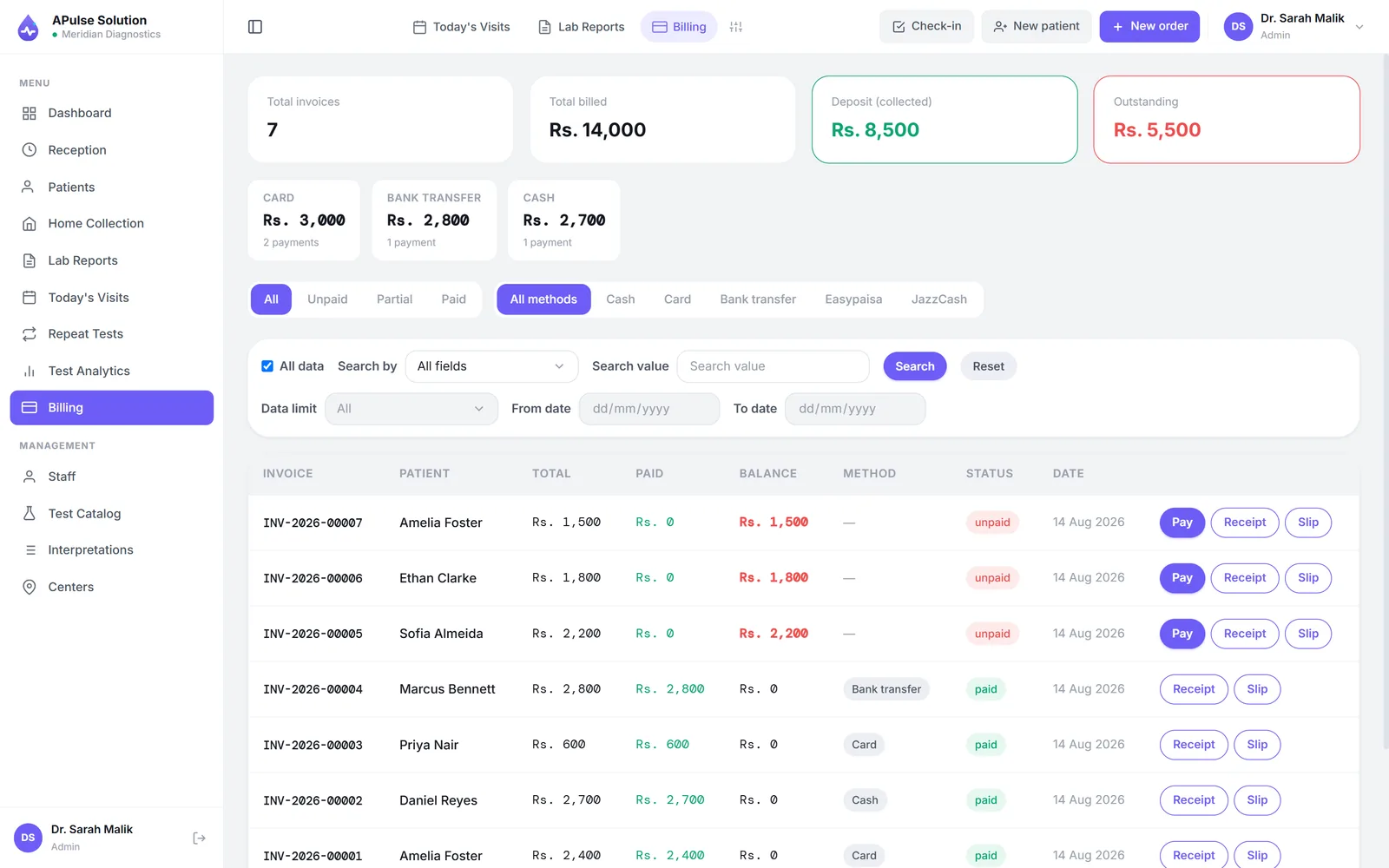
In A Pulse Solution this is commission tracking on the Medium and Premium plans: routine and special share percentages per doctor, and a printable daily, weekly or monthly share report. Premium adds an agreed price per test for each doctor, for arrangements structured that way rather than as a percentage. Referring doctors can also be given a login that shows only their own patients, which changes the character of the relationship — the doctor can see the count as it accumulates rather than receiving a total at the end and being asked to accept it.
The point is not the arithmetic, which was never hard. It is that both parties read the same document, and that the document was produced as a by-product of the day's work rather than assembled afterwards by one interested party.
A Worked Example
Illustrative figures — these are arithmetic, not market rates or a recommendation.
Suppose a lab and a doctor have agreed 15% of the amount actually collected, with the month running on calendar dates. In one month the doctor's referrals produce:
| Referral | Listed | Discount | Collected | Share at 15% |
|---|---|---|---|---|
| Patient A — CBC + LFT | 2,400 | 0 | 2,400 | 360 |
| Patient B — Thyroid profile | 3,000 | 300 | 2,700 | 405 |
| Patient C — CBC | 900 | 0 | 900 | 135 |
| Patient D — Lipid profile | 2,200 | 200 | 2,000 | 300 |
| Patient E — cancelled, sample rejected | 1,500 | — | 0 | 0 |
| Total | 10,000 | 500 | 8,000 | 1,200 |
Three things this table settles that a notebook would not:
The base is explicit. The share is on collected, not listed. On listed amounts the total would have been 1,500 rather than 1,200 — a 300 difference that is exactly the kind of gap that becomes a conversation. Both readings are defensible; only one of them was agreed.
The cancelled test is visible rather than absent. Patient E appears in the record with a zero, so the doctor can see it was received and why it earned nothing. A missing row invites the question "what happened to the patient I sent on the 14th?"; a zero row answers it.
Discounts are attributed. 500 given away, visible to both sides, on named invoices.
Run the same table with a fixed fee per test and the discount column stops mattering — which is the trade-off between the two models in one line.
Settlement Day Checklist
Six items. Doing these turns settlement from a negotiation into an administrative step.
- Agree the period in advance — calendar month, and whether a referral belongs to the month it was registered or the month it was paid. Say which.
- Send the itemised report, not just the total. A total invites doubt; a list of dated invoices with patient identifiers, amounts and shares does not.
- Show the zero rows — cancelled, unpaid, refunded — rather than omitting them.
- Reconcile before paying, not after. Give the doctor a window to raise a query while the invoices are still fresh in everyone's memory.
- Pay on a fixed date through a traceable method, and keep the record with the period's report. Predictability is worth as much to the relationship as the amount.
- Diarise a review date for the rates themselves, so a fixed fee agreed against old prices does not silently drift.
Keeping It Professional
Three points worth stating directly.
Patient privacy applies to referral reporting. A referring doctor is entitled to see the patients they referred; they are not entitled to a general window into your patient base. Role-based access — a doctor login scoped to their own patients — is the mechanism that keeps this correct rather than depending on whoever compiles the report remembering to filter it.
The arrangement should not touch what gets tested. The line that keeps this defensible is that the referral relationship is about where a test is performed, not about which tests are ordered. Anything that creates pressure on the second is a different thing entirely, whatever it is called.
Written beats remembered. A one-page agreement covering rate, base, discount treatment, exclusions, period and review date costs an afternoon and pre-empts nearly every dispute in this article. Relationships that have run for years on an understanding are exactly the ones where a misunderstanding is most expensive.
If you would like to see how the tracking works in practice, commission tracking is on the Medium and Premium plans, and the free demo runs every feature for 7 days with up to 10 patients.
Frequently Asked Questions
What commission percentage do labs in Pakistan pay doctors? We do not publish a figure, because there is no audited source for one and an invented "market rate" would be used as a bargaining position in other people's negotiations. Rates are negotiated per relationship. What matters more than the number is that the rate, the base it applies to and the discount treatment are written down.
Should commission be calculated on the listed price or the collected amount? Either works as long as it is agreed in advance and applied consistently. Collected is the more common reading and handles discounts naturally; listed is simpler but means the lab absorbs the whole discount. The dispute is never about which is right — it is about which was agreed.
How do we handle a patient who names a doctor but has no prescription? Make it a written policy rather than a per-patient decision at the counter, and tell both your staff and your referring doctors what the policy is. Either answer is defensible; an inconsistent answer is not.
What about cancelled or unpaid tests? Decide in advance and show them in the report as zero rows rather than omitting them. Visible exclusions build trust; missing rows invite questions that are tedious to answer weeks later.
Can the referring doctor see their own numbers directly? In A Pulse Solution, yes — referring doctors can be given a login scoped to their own patients only. Live visibility tends to prevent disputes rather than resolve them, because there is no month-end surprise to disagree with.
Which plan includes commission tracking? Medium and Premium. The referring doctor can be recorded at registration on any plan; the automatic share calculation and the printable share report arrive with Medium, and per-doctor test pricing is the part Premium adds.