LIMS Software
A laboratory information management system for clinical labs — every sample tracked from order to verified report, records kept and searchable, all in the browser with nothing to install.
What LIMS software means
LIMS stands for laboratory information management system. The term grew up in research and industrial laboratories, where the sample is the centre of the world: a classic LIMS logs a specimen the moment it arrives, moves it through a defined workflow, records who did what to it at every step, and keeps the surrounding records — reagent stock, sign-offs, results — attached to it.
Clinical laboratories developed a parallel tradition. Their software grew up around the patient rather than the sample, and came to be called an LIS — a laboratory information system. Same instinct, different starting point, and the vocabulary has been tangled ever since.
LIMS vs LIS — and why the difference matters less than it used to
On paper the distinction is tidy: a LIMS tracks samples through a workflow, an LIS tracks patients through a visit. In practice, a medical lab searching for either term today wants one system that does both — register the patient, follow the sample, enter the result, verify it, issue the report, raise the invoice. Modern software for clinical labs sits squarely on that overlap. We walk through the patient-centric lifecycle in detail on the laboratory information system page; this page looks at the same product from the sample's side.
A cloud LIMS for clinical labs
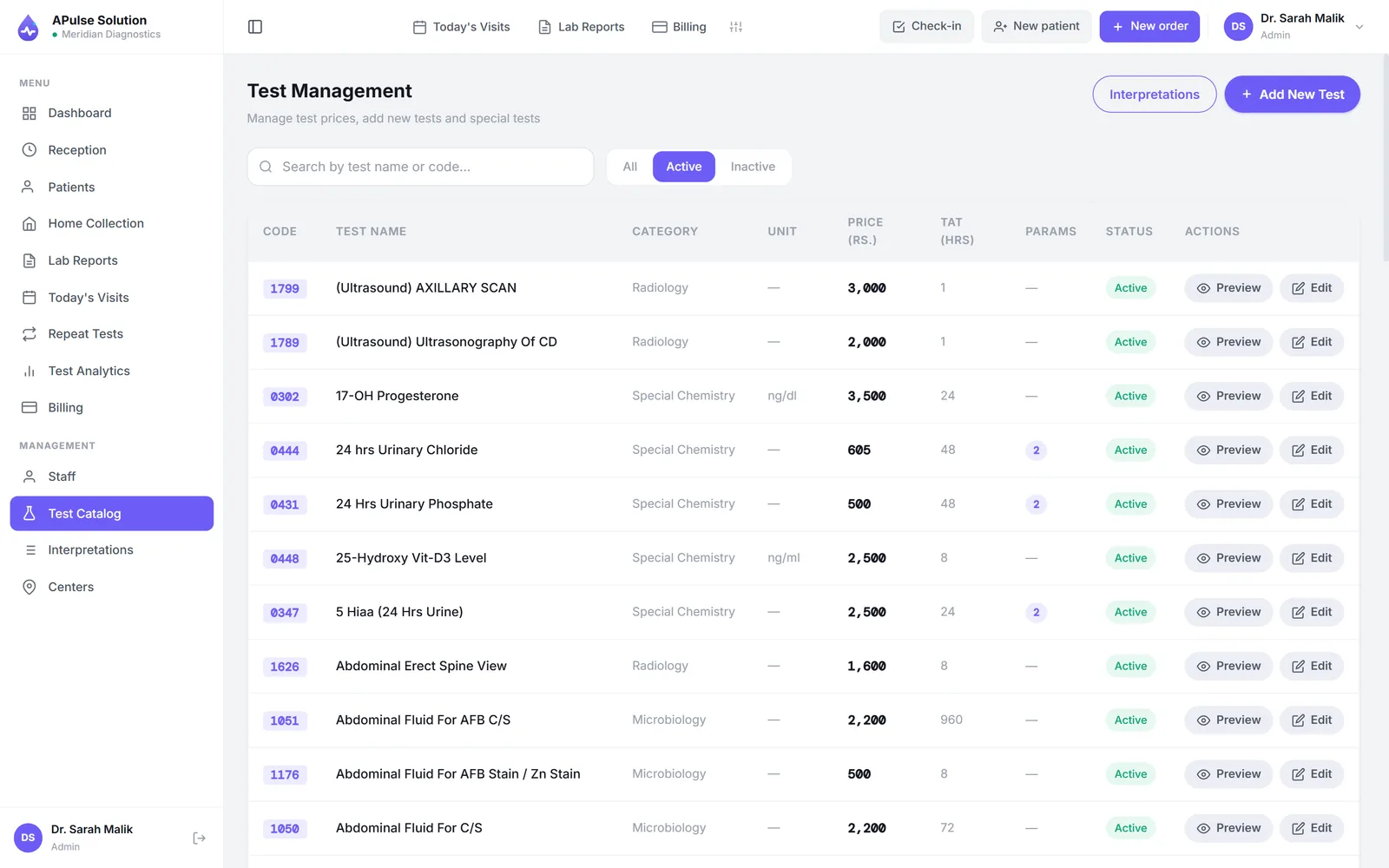
A Pulse Solution is a cloud LIMS built for medical, pathology and diagnostic laboratories. It runs in the browser on any computer, tablet or phone — nothing to install, no server to buy — with each lab's data held in its own isolated database schema in the cloud. The workflow it manages will be familiar to anyone who has run a bench:
- Ordered — tests booked at registration, priced from your own test catalog
- Collected — walk-ins join today's visit queue; doorstep samples are tracked from pending to scheduled to collected
- Resulted — technicians enter values against gender-specific reference ranges, with dropdown values for qualitative tests
- Verified — abnormal results are flagged automatically before anything is printed
- Reported — a branded PDF under your lab's own name and logo, ready to print, download or share
Around that workflow sit the records a working lab actually needs: a printable technician worksheet with CSV export, report search by patient, doctor or reference, billing raised at the moment of registration, and a daily revenue summary. On Medium and Premium plans the stock and inventory module tracks reagents and consumables with request approvals, so the bench that is about to run out of a kit says so before it does. Everything included is listed on the features page, and it all belongs to one wider lab management platform rather than arriving as a bolt-on module.
What A Pulse Solution deliberately is not
A term as broad as LIMS deserves an honest edge. APulse is not a research or pharmaceutical LIMS. There is no electronic lab notebook and no batch or manufacturing QC module, and while clinical quality control is built in — Levey-Jennings charts, Westgard multirules and a gate that holds results for an analyte whose control failed — it is the quality system a clinical lab is inspected on, not a manufacturing one. HL7 works one way only: analysers can post results in once analyser interfacing is switched on for your account (on request, on any plan), but there is no HL7 feed out into a hospital system. Labs that need those things need a different class of software, at a different class of price.
For a clinical lab that registers patients, runs their samples and sends out reports, that restraint is the point: one system reception and bench staff share, on three plans quoted for your lab's size, in PKR or USD — see what each plan includes or ask for a quote. The free demo creates your own workspace with every feature unlocked, up to 10 patients over 14 days, no card required.
Track your first sample in the demo — or see how much of a lab's day the same system quietly automates.
Frequently Asked Questions
What is LIMS software?
LIMS stands for laboratory information management system — software that tracks samples through a lab's workflow and keeps the records around them, from reagent stock to reports. A Pulse Solution is a cloud LIMS for clinical labs: it follows each sample from order through collection, result entry and verification to a branded PDF report, with billing handled in the same place — and stock and inventory on Medium and Premium plans.
What is the difference between a LIMS and an LIS?
Historically a LIMS was sample-and-workflow-centric software from research and industrial labs, while an LIS grew up around patients in clinical labs. For a modern medical laboratory the two terms largely describe the same thing — one system that registers the patient, tracks the sample and issues the report. APulse sits on exactly that overlap.
Is A Pulse Solution a research or pharmaceutical LIMS?
No — it is built for clinical laboratories: medical, pathology and diagnostic labs. There is no electronic lab notebook and no batch or manufacturing QC module. Clinical quality control is built in on every plan — Levey-Jennings charts, Westgard multirules and a gate that holds results for an analyte whose control has failed — but that is the quality system a clinical lab is inspected on, not a manufacturing one. Instrument interfacing exists on the Premium plan, inbound only. If your lab registers patients and sends out reports it fits; a research bench needs a different class of software.
How much does LIMS software cost?
We quote each lab individually, because the price depends on your report volume, staff accounts and branches. Message us on WhatsApp or use the quote form with your daily patient count and we'll send the price in writing, for monthly or yearly billing. The free 7-day demo, with every feature unlocked, needs no card. Basic covers up to 300 reports a month, Medium up to 2,000, and Premium is unlimited for multi-branch labs.
Can a small lab use a LIMS?
Yes — a LIMS is not only for large laboratories. The Basic plan covers a single lab with 3 staff accounts and 300 reports a month, and because APulse runs in the browser there is no server to buy or software to install. Start with the free demo: every feature unlocked, up to 10 patients for 7 days, no card needed.
Further reading
Background reading on how this software category works — written to inform, not to sell.
Ready to Get Started?
Create your free demo lab in seconds — every feature, 10 patients, no credit card. Or ask us for a quote and we'll set everything up for you.