Here is the short answer, so you can stop reading if it is all you needed.
LIS — laboratory information system — grew up in clinical laboratories, and it is built around the patient: a person walks in, tests are ordered under their record, results are checked against reference ranges, and a report goes to them and their doctor.
LIMS — laboratory information management system — grew up in research, pharmaceutical, environmental and industrial quality-control labs, and it is built around the sample: a specimen arrives with an identifier, gets split, stored, tested and tracked, and the unit of work is the sample rather than the person it came from.
And the part vendors rarely say out loud: for medical labs the two words now describe broadly the same products. Buyers search both terms, so vendors answer to both. If you are choosing software for a diagnostic lab, the acronym on the box tells you almost nothing useful, and comparing feature lists against your own workflow tells you everything.
The rest of this article explains where the difference came from, why it stopped mattering in this market, and what to compare instead. We build laboratory information system software for medical labs, which is a bias worth knowing about while you read.
Where the Two Terms Came From
The split is historical, not technical.
LIS came out of hospital computing. The problem being solved was a clinical one: a hospital laboratory receiving orders from wards and clinics, producing results that had to reach the ordering doctor attached to the right patient, with reference ranges, abnormal flags and a pathologist's sign-off. Everything in that world organises itself around the patient record, because that is what the rest of the hospital is organised around too.
LIMS came out of industrial and research laboratories. There, the questions are different: which batch did this specimen come from, where is it physically stored, who handled it, which protocol was followed, and does the audit trail hold up to inspection. There may be no patient at all — the sample might be river water, a drug formulation or a soil core. The sample is the record.
The vocabulary stuck long after the products started converging, mostly because both categories eventually needed the same underlying machinery: a catalogue of tests, structured result capture, reporting, users with permissions, and an audit trail. What differs now is emphasis, not architecture.
What an LIS Emphasises
If you run a diagnostic lab, this is the world your software lives in, whatever it calls itself.
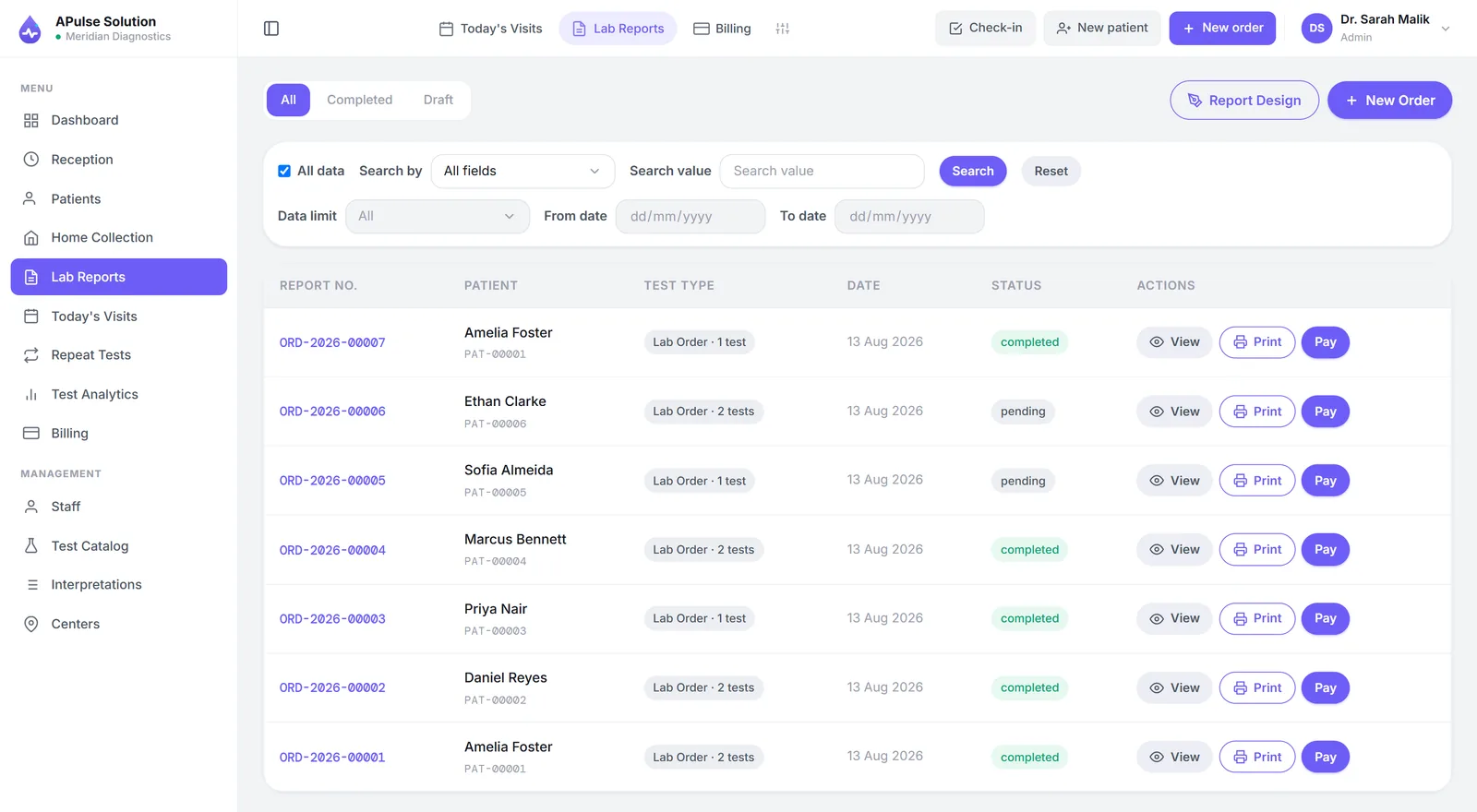
The patient as the durable record. A medical record number issued once and reused forever, demographics captured at first registration, and a visit history that answers "has this person been here before, and what were their numbers last time?"
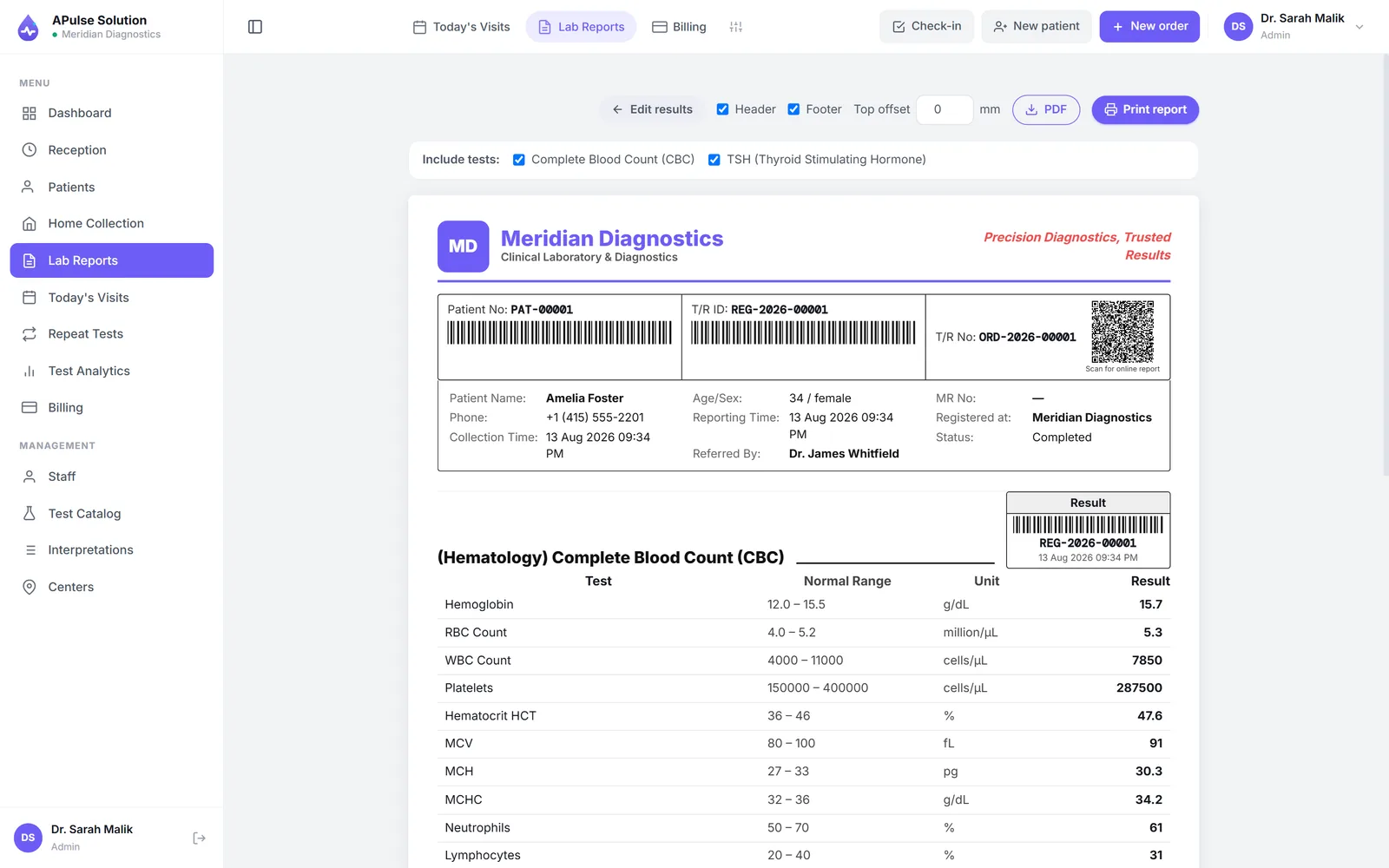
Clinical result handling. Tests carry units and reference ranges, ranges vary by sex where that is clinically relevant, out-of-range values are flagged rather than left for a human to notice, and there is a review step before anything is released.
Output aimed at doctors and patients. A branded report that reads the same whoever produced it, delivered as paper at the counter or as a PDF on the patient's phone. Referral tracking, because in this market a large share of walk-ins arrive with a doctor's name attached. Billing tied to registration, because the lab is also a business with a counter.
What a LIMS Emphasises
The sample-centred world, sketched briefly so you can recognise whether you are in it.
The specimen as the record. Batches and aliquots, chain of custody, physical storage locations, freezer positions, retention and disposal schedules. Where a clinical system asks "whose result is this?", a sample-centred system asks "where is tube 4 of batch 118, and who has touched it?"
Protocol and workflow management. Standard operating procedures encoded into the system, stage-by-stage sign-offs, method validation records, and instrument calibration histories kept because an auditor will ask for them.
Instrument integration as a first-class concern. In high-throughput industrial QC, capturing results directly from instruments is normal rather than a premium extra. This is worth naming clearly, because it is one of the places the two worlds genuinely differ in cost: enterprise-scale interfacing is a real capability with a real price tag, and it is not what a small diagnostic lab is buying.
Why the Terms Blur for Medical Labs
Three forces pushed the words together, and only one of them is technical.
The products converged. Any system serving a diagnostic lab has to do registration, results, reports and billing. Once a LIMS vendor added patient records to sell into clinical labs, and an LIS vendor added sample tracking to sell into hospital histopathology, the feature lists started to rhyme.
Search drove the naming. Lab owners search both terms, and a vendor whose page only says "LIS" is invisible to everyone typing "LIMS". So vendors use both, on the same product. It is worth being straightforward that this is what is happening rather than pretending there is a principled distinction behind every product name — including ours, which appears under LIMS software, lab management system and laboratory information system, all describing the same thing.
Regional usage varies. In Pakistan, "lab management system" or "lab software" is what most owners actually say; LIS and LIMS turn up mainly in vendor marketing and in imported documentation.
The practical consequence: stop trying to work out which acronym you need. Write down what your lab does in a day, and check candidate products against that list.
Which One Does Your Medical Lab Need?
If patients walk into your building and reports go out to doctors, you need patient-centred software. Here is the short test — every item should be a yes:
- Registration with permanent medical record numbers, and a search fast enough that a returning patient is found rather than registered a second time.
- A test catalogue holding your own names, prices and reference ranges, editable by you rather than by the vendor's support queue.
- Result entry checked against those ranges, with abnormal values flagged automatically and the flag surviving onto the printed report.
- Branded PDF reports with a layout that does not vary between staff or between days.
- Billing raised at registration, with discounts and dues recorded against the visit, and a day-end total you do not assemble by hand.
Then, as the lab grows: referral commission tracking if you pay doctor shares, stock control for reagents and consumables, multi-branch operation on one system, and a way for patients to collect their own reports without queueing at the counter. In A Pulse Solution those sit on the Medium and Premium plans, and the pattern is similar across vendors — growth features live in higher tiers, so it is worth knowing which tier you will need before you sign rather than after.
When a true sample-centred LIMS is the right call instead: if you run a research, industrial, environmental or QC laboratory with no patient traffic, most of the list above is irrelevant to you and the storage, batch and chain-of-custody features you actually need are missing from clinical products. That is a genuinely different purchase, and this is not the article for it.
Questions to Ask a Vendor, Whichever Term They Use
The acronym is noise. These five questions are signal, and they work on any product:
- Show me one real patient, end to end — registration, order, result entry, report, invoice — without switching to slides.
- How do results get in? If entry is manual, what catches a transposed digit? The answer should involve stored reference ranges and automatic flagging, plus a review step before release.
- Who controls the test catalogue and rate list — can my own staff add a test and change a price, or does that go through you?
- What are your real support hours, channel and language? Labs work evenings and weekends; front-desk staff need help in the language they are comfortable in.
- If I leave, what data do I get back, in what format, and at what cost?
A vendor who answers all five plainly is showing you how the relationship will run after the sale. A vendor who redirects to a call is showing you that too.
If you want to see the whole loop rather than read about it, the free demo creates your own workspace for 7 days with up to 10 patients — bring a slice of your rate list and run the five questions above against it yourself.
Frequently Asked Questions
Is LIS or LIMS better for a pathology lab? Neither term answers the question. A pathology lab needs patient-centred features — registration with permanent record numbers, reference ranges with flagging, branded reports, billing at registration — and products marketed under both acronyms provide them. Judge the feature list, not the name.
Do LIS and LIMS mean different things in Pakistan? Not reliably. Most owners here say "lab software" or "lab management system"; LIS and LIMS appear mainly in marketing material and imported documentation, often on the same product.
Can one system be both an LIS and a LIMS? Many claim to be, and for a diagnostic lab that claim is usually harmless — it means the product covers patient records and calls itself both to reach both audiences. It becomes a real problem only if you need genuine sample-management features such as chain of custody or storage location tracking, which most clinical products do not have.
Does an LIS include billing? Not always, and it matters more here than in hospital settings. In a standalone diagnostic lab, billing at registration is what stops tests being performed and never charged, so treat it as core rather than as an add-on module.
Is a LIMS the same as a hospital management system? No. A hospital management system covers admissions, wards, pharmacy and OPD; a LIMS or LIS covers the laboratory. Labs inside hospitals often run a lab system that exchanges data with the hospital system, but they are separate products with separate jobs.