Hospital Management System
OPD tokens, wards and beds, the emergency room, the operation theatre, dialysis, the pharmacy and radiology — in the same software as your laboratory, with one patient file and one billing desk. Our team switches on the departments your hospital runs.
The lab and the hospital, in one system
A Pulse Solution began as laboratory software, and the hospital departments are built into the same application rather than bolted on beside it. A patient registered at the lab counter is the same patient the OPD gives a token to, the ward admits and the pharmacy sells to. Every hospital bill is an ordinary bill, so payments, receipts, refunds, the cashier's shift close and the accounts include them without a second system.
Each department is switched on by itself: a clinic with an OPD and a lab, a dialysis centre, or a full hospital with wards, an emergency room and a theatre. A department you do not run does not appear in the menu, and switching one off later hides it while keeping its records.
The Hospital Overview puts every department on one screen: today's figures for each, the money due on hospital bills (for staff allowed to see it), who is sitting in OPD with their queue, and a needs attention list — a level-1 emergency patient still waiting, the ICU full, a dialysis patient whose latest readings are out of range, imaging studies waiting for a report, and bills unpaid for more than a day.
OPD — consultants, tokens and prescriptions
- Departments to start from (General Medicine to Physiotherapy, seventeen in all), renamed or hidden as you like
- Consultants with an OPD fee, a follow-up fee and window, the doctor's share, a room, and weekly sittings with an optional token limit
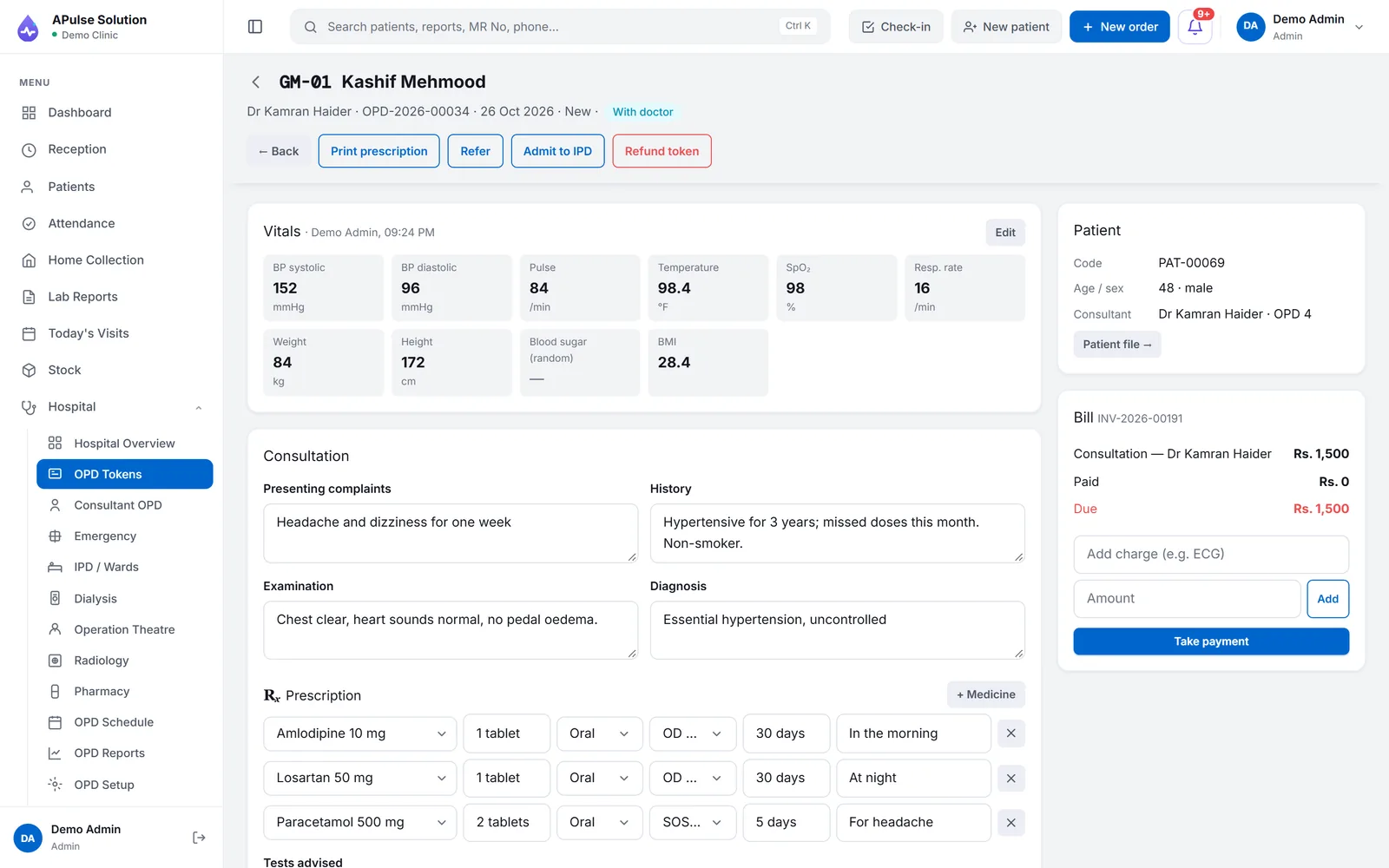
- A token and a bill for every visit, one series per consultant per day; a revisit inside the follow-up window is charged the follow-up fee by itself
- Each consultant's lane on the OPD board: who is being seen, the next tokens and how many are waiting
- The consultant's screen: vitals, complaints, history, examination, diagnosis and the prescription — medicine, dose, route, frequency and duration — with an earlier prescription repeated in one click, printed on A4
- Tests advised are picked from your own lab's catalogue, and the desk turns them into a lab order with its bill in one step
- Referral to another department books the patient with that consultant, carrying today's vitals and the reason
- The patient's history on every consultation: visits in every department, every medicine prescribed, their lab results and their dialysis sessions
- The consultant payout: visits, new and follow-up, what was billed and collected, the doctor's share and the hospital's — the share is fixed on each visit when it is booked, so changing a consultant's percentage never rewrites a past payout
IPD — wards, beds and the running bill
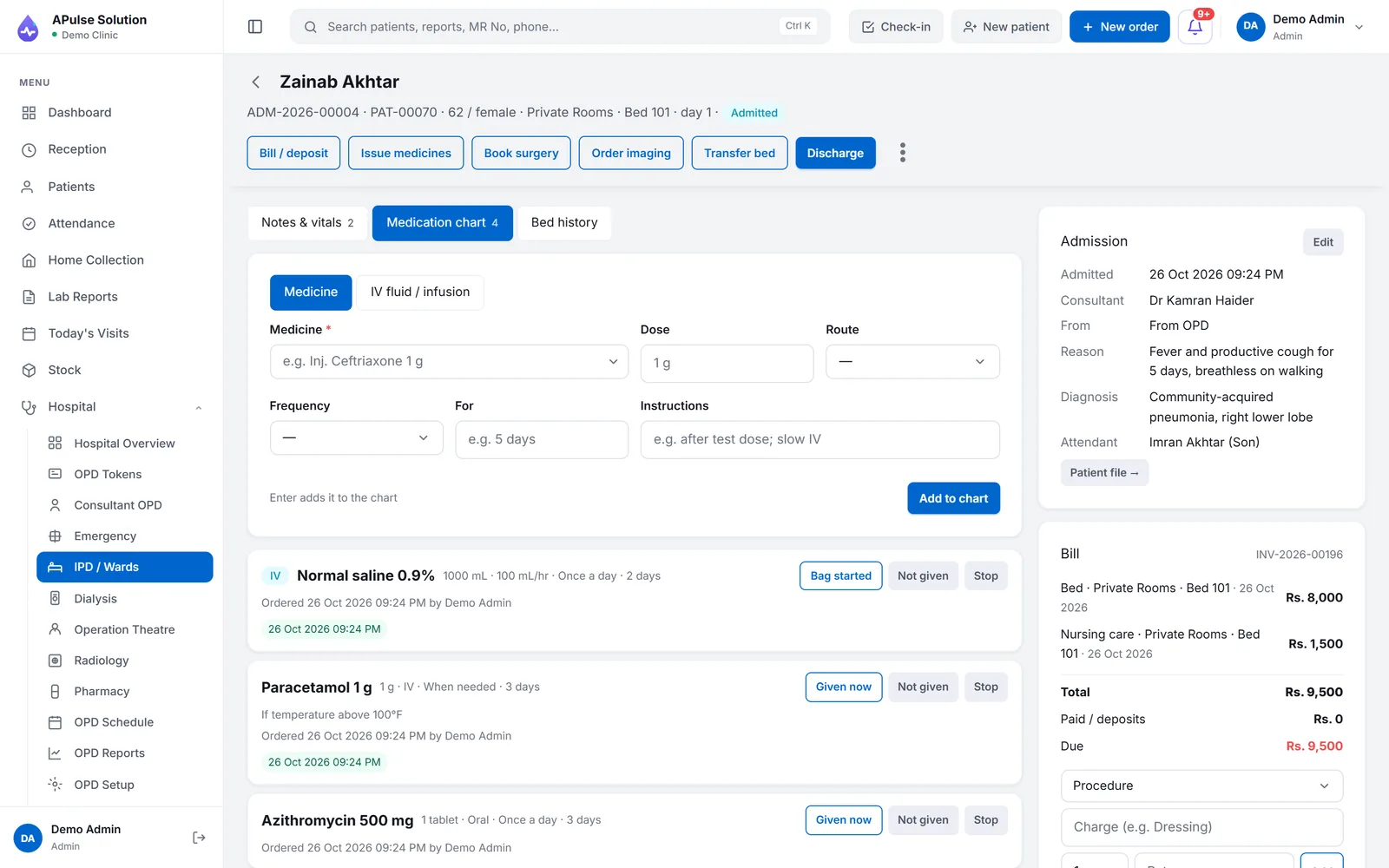
- Wards with a daily bed and nursing charge, beds that may carry their own rate, and a bed board showing every bed, free or with its patient, day of stay and consultant
- Admission from the bed board, the patient file, an OPD visit or the emergency room; one patient per bed and one open admission per patient, even when two desks try at once
- Nursing notes and doctor's rounds with vitals, struck out rather than edited; a round can charge the doctor's ward-round fee
- A medication chart for medicines and IV fluids (bag, volume and rate), with every dose recorded as given, or not given and why
- One running bill for the stay: the admission charge, then a bed-day and a nursing-day line for every day, at the rate of the bed the patient was in; procedures, medicines and investigations added as they happen, deposits taken as payments
- Discharge with its type, the final diagnosis and home medicines filled in from the chart, and a printable discharge summary; a hospital can require the bill settled first, and only someone allowed to let a balance stand can override it, with the reason recorded
Emergency — the triage board
- Arrival with a triage level from 1 (resuscitation, red) to 5 (non-urgent, blue), triage vitals including GCS and pain score, the chief complaint and how the patient arrived
- Medico-legal cases with the MLC and FIR numbers and the police station
- A board of everyone still in the ER, the most urgent first, with a waiting clock that turns red after 30 minutes
- Re-triage with a reason, nursing and doctor's notes, and an ER bill opened with the ER fee
- The outcome — discharged, admitted, referred out, LAMA, death or absconded — with admission going straight into a free IPD bed, and a printable ER record or MLC sheet
Operation theatre
- A day view for each theatre; surgery is booked for an admitted patient, and no two bookings can overlap in one theatre
- A pre-operative checklist on the WHO sign-in — identity, site marked, fasting, allergies, investigations, blood, antibiotic, implants and the anaesthesia check — each tick stamped with who and when
- Surgery cannot start until every item is ticked; an emergency may start without them, and the skipped items are recorded
- The operation note — procedure, findings, complications, blood loss, specimens, implants, post-operative instructions — printed, with the surgeon's, anaesthetist's, theatre, recovery and consumable charges added to the admission's bill
The operation theatre works with IPD, because every operation belongs to an admission.
Dialysis
- Registration with the day's token and a session bill, and the patient assigned to a nurse, who sees them under My patients
- The session prescription — access, HBV, HCV and HIV status, dialyzer and reuse number, heparin, dry weight, target fluid removal, machine — and the pre-dialysis readings, with the weight gained since the last session shown
- Readings at any interval during the session, with low or high blood pressure, an abnormal pulse, low oxygen and fever flagged; a mistaken reading is struck out with a reason, never deleted
- Post-dialysis readings, complications, discharge with the next session date, and a printable session record beside the patient's earlier sessions
- A board with a column per stage of the session, and the machines in use
Pharmacy
- The hospital pharmacy's own medicine stock, kept apart from the lab's reagents — one store per hospital
- Stock received from suppliers by batch, expiry and cost; an already-expired batch is refused, and medicines at their reorder level or expiring within 90 days are listed
- Counter sales to a registered patient or a walk-in, with their own bill, and medicines issued to an admitted patient straight onto the admission's bill
- Every sale is taken from the batch that expires first, never from an expired one; a medicine short of stock stops the sale and says how much is left
- Returns go back on their batch and come off the bill
Radiology
- A study catalogue — X-ray, ultrasound, CT, MRI, mammography, fluoroscopy, Doppler, ECG, echo — with the price, a report template and the patient's preparation
- Orders with their own bill, or on the admission's bill for a patient on the ward
- Each study recorded as performed, drafted from its template, and signed by the reporting radiologist; a signed report is changed only by an amendment with a reason, and the earlier text is kept
- A printed report for each study on the hospital's header; an unsigned draft prints marked DRAFT
Radiology keeps the order and the report, not the images. It is not a PACS: the films and scans stay on the modality or your imaging system. A diagnostic centre can run radiology on its own, without any ward or OPD.
Doctors, staff and access
- Doctors & Fees: every doctor's fees on one screen — OPD and follow-up, the doctor's share, the ward round, surgeon and anaesthetist — and one record per doctor for lab referrals and OPD alike
- A doctor signs in to see their own OPD queue, their admissions, the emergency patients they attend and the operations they are on
- Nurse and Pharmacist roles beside the lab's, with each person's access set department by department; bill amounts are shown only to staff allowed to see money
- On request, the hospital departments can start with no access for anyone, the administrator included, until each person is ticked
- Staff attendance: everyone checks themselves in and out, a late arrival after the grace minutes is marked, with daily and monthly sheets, leave types and night shifts
What to know before you choose it
A hospital's lab reports are not put online. Once OPD, IPD, the emergency room, the theatre or dialysis is switched on, the account counts as a hospital: the QR code on the billing slip and the patient's report link stay off, and reports are printed or downloaded as PDF. The archived report PDFs are kept inside the hospital's own database rather than in file storage. Radiology or the pharmacy on their own do not change this, so a diagnostic centre keeps its online reports.
Attendance is self check-in. There is no import from a biometric machine yet. Radiology stores no images, as above. Staff accounts and branches still follow the lab plan's limits — up to 25 staff and 5 branches and collection centres on Premium — and we raise either on request.
The departments are new: they arrived in October 2026, and the release notes list what has changed since.
How to get it
The hospital departments are not part of any plan. Our team switches on the ones your hospital runs, one at a time or all together, on top of whichever lab plan you are on, and includes them in your written quote. They are off in a new free demo; tell us and we switch them on for your demo so you can run a morning's OPD through it first. A hospital that only wants software for its laboratory department should read the hospital laboratory page instead, and a dental practice the dental clinic software page.
Tell us your departments on WhatsApp or open a free demo and ask us to switch the hospital on.
Frequently Asked Questions
Which hospital departments does A Pulse Solution cover?
OPD with consultants, tokens and prescriptions; IPD with wards, a bed board, the medication chart and a running bill; the emergency room with triage; the operation theatre; dialysis; the hospital pharmacy; radiology orders and reports; and staff attendance — beside the laboratory, with one patient file and one billing desk. Each department is switched on by itself, and a dental module is available the same way.
Is the hospital system part of a plan?
No. Our team switches on the departments your hospital runs, on top of whichever lab plan you are on, and includes them in your written quote. Staff accounts and branches still follow the plan's limits, and we raise either on request.
Can patients open their lab reports online at a hospital?
No. Once OPD, IPD, the emergency room, the operation theatre or dialysis is switched on, the account counts as a hospital: the QR code on the slip and the patient's report link stay off, reports are printed or downloaded as PDF, and the archived PDFs are kept in the hospital's own database. Radiology or the pharmacy on their own do not change this.
Does the radiology module store X-ray and scan images?
No. It keeps the imaging order, its bill and the radiologist's report, drafted from a template and signed; it is not a PACS, so the images stay on the machine or your imaging system. The dental module is different: it keeps X-rays and scans on the patient's record.
Can each doctor see only their own patients?
Yes. A doctor signs in to their own OPD queue, their admissions, the emergency patients they attend and the operations they are on. Bill amounts are shown only to staff allowed to see money, and each person's access is set department by department.
Does staff attendance work with a biometric machine?
Not yet. Every account checks itself in and out in the software, a late arrival after the grace minutes is marked, and the administrator gets daily and monthly sheets with leave and night shifts. Importing from a biometric machine is not built.
Can we try the hospital system in the free demo?
Yes, on request. The hospital departments are off in a new demo; message us and we switch on the ones you want to try, so you can run real OPD tokens, admissions and bills through it before deciding.
Further reading
Background reading on how this software category works — written to inform, not to sell.
Ready to Get Started?
Create your free demo lab in seconds — every feature, 10 patients, no credit card. Or ask us for a quote and we'll set everything up for you.